
The Image Format Decision Nobody Talks About (Until Their Site Breaks)
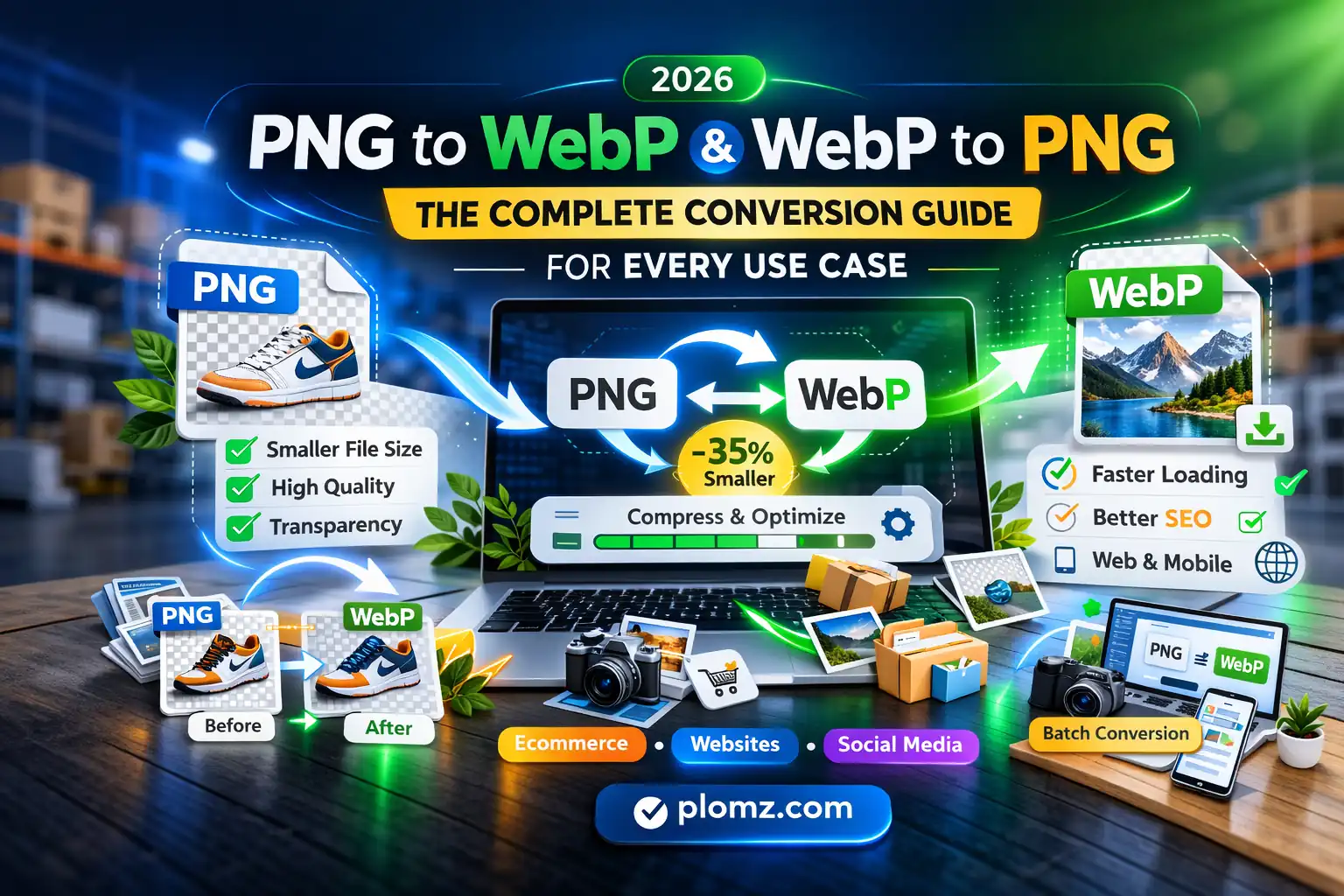
Description: Learn when and how to convert PNG to WebP or WebP to PNG for web performance, ecommerce, design, and batch workflows. Step-by-step professional guide.
The Image Format Decision Nobody Talks About (Until Their Site Breaks)
Why PNG vs WebP Isn't a Technical Question — It's a Workflow Question
Most guides will tell you WebP is smaller and PNG is better for editing. You already know that. What they won't tell you is why teams keep making the wrong choice — and what it costs them when they do.
This isn't a comparison article. It's a decision framework built around how images actually move through a real production pipeline.
The Fundamental Misunderstanding
Developers optimize for delivery. Designers optimize for fidelity. These two goals are not in conflict — but they operate at different stages, and confusing the stages is where problems begin.
The question is never really "PNG or WebP?" The right question is: "Where in the lifecycle is this image right now?"
- Is it being created or edited? → It belongs in PNG
- Is it being served to a user? → It belongs in WebP
- Is it being submitted to a platform or printed? → It may need to go back to PNG
This lifecycle thinking changes everything about how you manage image assets.
Stage 1 — Creation (Always PNG)
PNG is a working format. Its lossless compression means every pixel survives every save. When a designer exports a logo, a UI element, or a product photo backdrop, PNG preserves the exact data needed for future edits — transparency channels, sharp edges, color accuracy.
The mistake most teams make: Receiving a WebP from a client or CMS and attempting to edit it directly. WebP was built for delivery, not manipulation. Editing it introduces compression artifacts on re-export and strips out layer-compatible data.
The fix: Before any editing begins, convert WebP → PNG first. Use: https://plomz.com/webp-to-png
Stage 2 — Production Deployment (Always WebP)
This is where PNG becomes a liability.
A 400KB PNG product image served across 10,000 daily page views generates roughly 4GB of bandwidth per day — just for one image. Convert that to WebP and you're looking at 250–280KB per image. That's not a marginal improvement; it's infrastructure-level savings.
More critically, Google's Core Web Vitals scoring penalizes pages with oversized images. The Largest Contentful Paint (LCP) metric — one of the three signals that directly influence search rankings — is disproportionately affected by unoptimized image formats.
Converting PNG → WebP before deployment isn't optional for competitive websites. It's baseline hygiene. Use: https://plomz.com/png-to-webp
The Hidden Cost Most People Calculate Wrong
Teams focus on file size. They should focus on compounding cost.
Consider an ecommerce catalog with 3,000 product images:
| Format | Avg. File Size | Total Size | Monthly CDN Cost (est.) |
|---|---|---|---|
| PNG | 420KB | ~1.26GB | ~$38 |
| WebP | 290KB | ~870MB | ~$26 |
| Savings | ~31% | ~390MB | ~$12/month |
That's $144/year on CDN alone — before factoring in faster load times, lower bounce rates, and improved conversion rates from a snappier experience. For high-volume platforms, this scales into thousands of dollars annually.
Stage 3 — Compatibility Handoff (Back to PNG)
Here's the stage most guides skip entirely.
When your images leave your controlled environment — submitted to a marketplace, inserted into a PowerPoint deck, sent to a print vendor, or uploaded to a legacy CMS — WebP regularly fails silently. The file uploads. The preview breaks. The client calls.
Platforms like older versions of WordPress, certain email clients, and virtually all print workflows have unreliable or zero WebP support. This isn't a bug you can fix on your end. It's a format mismatch.
The professional move: Maintain a PNG master of every production asset. When a handoff moment arrives, convert from the master — not from the deployed WebP.
The Pipeline That Actually Works
Here's how high-output teams structure this:
[Design Tool] → Export PNG (Master Archive)
                      ↓
              [Batch Convert PNG → WebP]
                      ↓
              [Deploy to Website/CDN]
                      ↓
         [Need to edit? Convert WebP → PNG]
                      ↓
              [Re-export PNG → WebP]
                      ↓
              [Redeploy]
For document-sourced visuals (presentations, reports, scanned assets):
[PDF Source] → Convert via plomz.com/pdf-to-jpg
                      ↓
              [Clean up in PNG]
                      ↓
              [Convert PNG → WebP for web use]
This two-format system — PNG as the archive, WebP as the delivery layer — eliminates format-related rework almost entirely.
Batch Processing: Where the Time Actually Goes
Single-image conversion takes seconds. The real time sink is managing volume.
A photographer delivering 200 edited images, a developer migrating a media library, or an agency launching a new site with 500 assets — these scenarios don't need a better converter. They need a batch-capable converter that doesn't require a local installation, licensing fees, or a developer to run a script.
Practical batch workflow:
- Organize source PNGs into a single folder
- Upload and batch convert at https://plomz.com/png-to-webp
- Download the WebP bundle
- Integrate into your deployment pipeline
For reverse batch (WebP → PNG for editing or handoff): https://plomz.com/webp-to-png
What "Visual Quality" Actually Means in This Context
Marketing copy says WebP is "near-lossless." That's technically true but practically misleading for some use cases.
For photographic content — hero images, product photography, lifestyle shots — the quality difference between PNG and WebP at standard compression levels is imperceptible to end users. A 30% file size reduction with zero perceivable quality loss is an unambiguous win.
For images with hard edges, text overlays, or flat color fields — icons, infographics, logos with type — the visual artifacts from aggressive WebP compression can become visible at high magnification. In these cases, use conservative compression settings or evaluate whether the PNG version is more appropriate for that specific asset type.
The rule: Photographs → WebP confidently. Precision graphics → test before deploying at scale.
Common Workflow Failures (And Their Root Causes)
"Our images look degraded after conversion" Root cause: Converting from an already-compressed WebP instead of the PNG master. Always convert from the highest-quality source.
"Our WebP images aren't displaying on the client's system" Root cause: Delivering WebP to an environment without WebP support. Maintain PNG fallbacks or convert before handoff.
"Batch conversion produced inconsistent results" Root cause: Source files had mixed resolutions or color profiles. Normalize source files before batch conversion.
"We lost the original and can only find the WebP" Root cause: No master archive policy. Every PNG master should be stored separately from the deployment-ready WebP copy.
The Actual Takeaway
PNG and WebP are not rivals. They are two formats serving two distinct roles in the same workflow.
The teams that struggle with image management aren't using the wrong format — they're using the right format at the wrong stage.
Archive in PNG. Deploy in WebP. Convert back when you need to edit or hand off. Handle document-sourced images by extracting through https://plomz.com/pdf-to-jpg before entering the pipeline.
Run conversions — single or batch — at:
- PNG → WebP: https://plomz.com/png-to-webp
- WebP → PNG: https://plomz.com/webp-to-png
The format you choose matters less than the system you build around it.
Understanding image format strategy as a pipeline decision — rather than a one-time format preference — is what separates teams that scale cleanly from teams that keep re-doing work they've already done.